AEO and GEO vs. SEO: The New Rules of Search
I have never seen a brand destroyed by silence. I have seen thousands destroyed by noise.
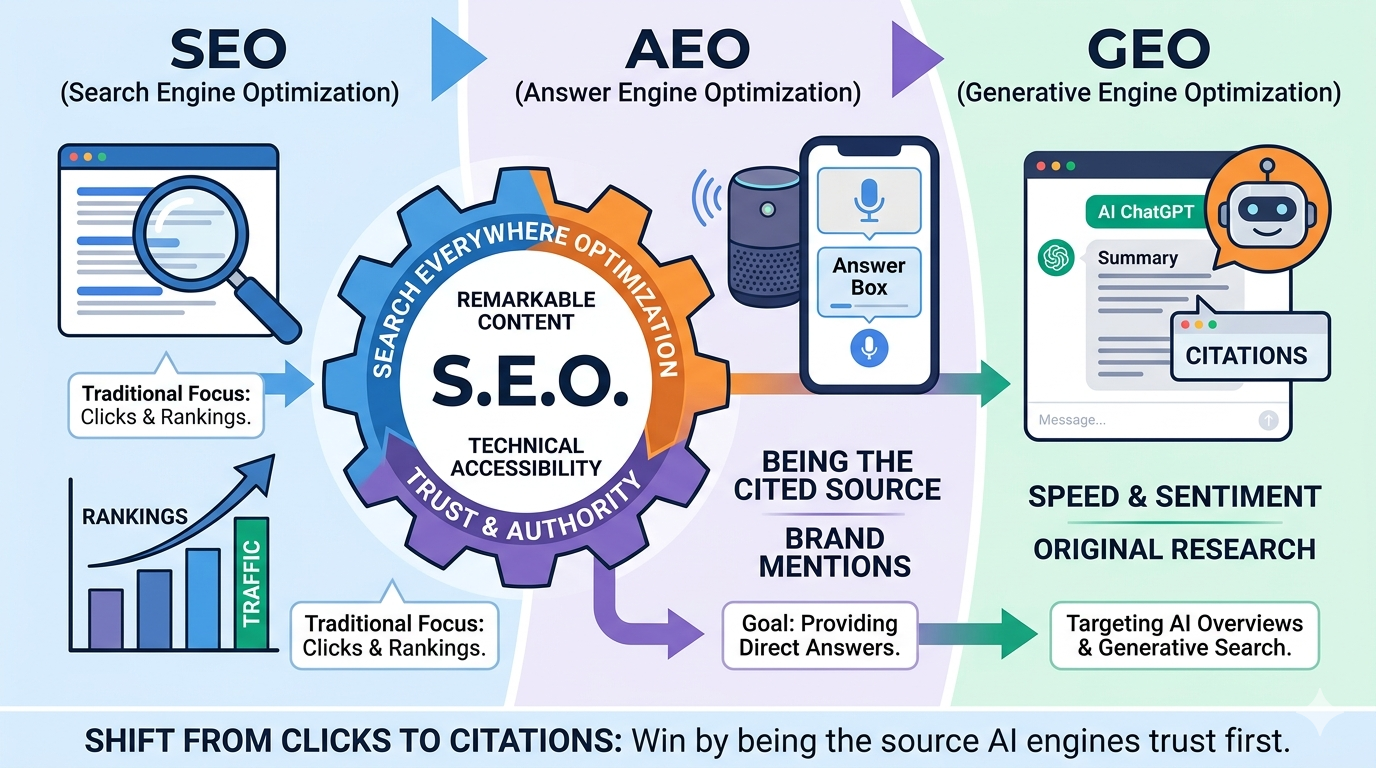
Today, the marketing world is drunk on three new acronyms: SEO, AEO, and GEO. They call it "Search Everywhere Optimization." I call it doing your job properly.
Let me tell you what is actually happening. And more importantly, what you must do about it.
THE NEW DISCOVERYDiscovery has fragmented beyond recognition
It used to be simple. A customer typed into Google. They saw ten blue links. They clicked. That world is dead.
Do not panic. This is not a crisis. It is an opportunity.
The customer is now educated before they arrive. They do their research inside the platform. They compare your prices. They read about your competitors. Then, and only then, do they type in your URL. By that time, they have already decided to buy. That is why conversion rates are higher than ever. You can grow revenue with less traffic. I have seen it with my own clients.
Stop optimizing for position one
That is a vanity metric from a bygone era. Optimize to be the cited brand. Optimize to be the source that AI engines trust first.
Ranking on ChatGPT is the new frontier. It is not mainstream yet. But it will be within 24 months. Early movers have a decisive advantage. Latecomers will burn money trying to catch up.
SEO
You still need remarkable content. Your site must be accessible. You must earn trust and authority. The difference is the scoreboard. SEO obsesses over rankings and click rates. AEO and GEO care about one thing: being mentioned.
Mentions > Links
A backlink is no longer the gold standard. A mention from a high-authority source is worth more. AI reads sentiment. It reads relevance. It is not fooled by cheap tactics.
What does AI actually want?
Trust
Brand mentions, sentiment, and authority are at the top of the list. AI needs to believe you before it recommends you.
Original Research
Fresh data. A unique point of view. Not the thousandth article saying the same thing.
Clarity
JavaScript is your enemy. LLMs do not crawl it well. If your pricing page is invisible, you are invisible.
I must warn you about something dangerous. Mass AI-generated content is a trap. It produces a short spike in traffic. Within six months, you sink below your baseline. You burn the algorithms. You burn the customer. You end up worse than when you started.
We tested this. When people merely think they are reading AI content, they disconnect. Engagement drops immediately. Write for human beings. Package it for machines. Never the other way around.
Three pillars. Six metrics.
1. Narrative
Use first-party research. Be quantitative. Saying "we are the best" means nothing when ten competitors say the same thing.
2. Technical
Make your site easy for bots to parse. Create content for humans. Package it for AI.
3. Trust
Get involved in community conversations. Reddit matters. YouTube matters. Digital PR matters.
Here are six metrics worth your time:
- Brand search growth
- Assisted conversions
- Share of voice across platforms
- Returning visitor growth
- AI citation visibility
- Conversion quality
But be careful. Visibility without context is useless. One of my clients was cited constantly in Germany. They were being recommended against. We only discovered this by looking at sentiment, not volume.
GEO works faster than SEO
You can see results quickly. You can pivot away from failure. Do not suffer from analysis paralysis. Most brands are moving too slowly. That is your advantage.
Your 90-day action plan. First two weeks: audit your AI visibility. See where you appear. See who appears instead of you.
Next 30 days: create content AI wants to cite. Publish original research. Refresh your old work.
Final 30 days: amplify. Build your authority strategy. Align your SEO, content, and PR teams. They cannot work in silos.
After 90 days, you will see quantifiable changes. If you do not, look in the mirror. Your content is not as good as you think.
Think long term
I have seen short-term hacks. Ten thousand YouTube videos with your company name stuffed into descriptions. It gives a quick boost. Then it collapses.
Do not do this. It is shortsighted. It is dishonest. Eventually, the platforms will penalize you. Digging yourself out of that hole is far more painful than building properly from the start.
The future of search is bigger than search itself. Your customers are discovering you across AI, social media, and community platforms simultaneously. Fewer clicks does not mean fewer sales. Win by becoming the source that AI engines trust first. Win by being the cited answer.
TEST YOUR WEBSITE FOR AI VISIBILITY →Your AEO & GEO questions
answered
Straight answers about AI search, no jargon.
Do I need to overhaul my SEO strategy to add GEO and AEO?
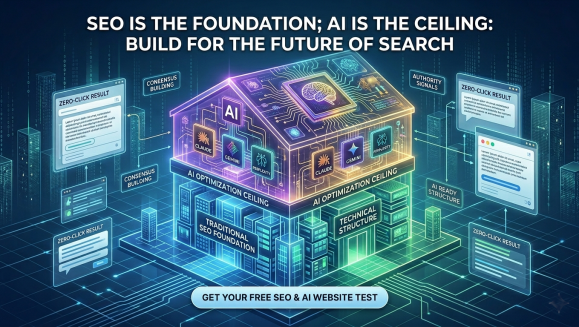
No. SEO is your foundation. GEO and AEO are layers that build on top of it. If your SEO is strong—good site speed, proper crawlability, clear keyword relevance—you are already halfway there. The tactics overlap heavily. Google itself has stated that optimizing for AI-powered search requires no fundamental changes from traditional SEO practices.
How is AEO different from GEO?
They describe the same underlying approach but with slightly different focuses. Answer Engine Optimization (AEO) focuses on earning visibility in direct-answer formats like Google's featured snippets, People Also Ask boxes, and voice assistant results. Generative Engine Optimization (GEO) focuses on getting your brand cited, recommended, or mentioned in AI-generated answers from platforms like ChatGPT, Gemini, and Perplexity. In practice, most marketers use the terms interchangeably.
Does AI search actually drive traffic to my website?
Yes, but not as much as traditional search—and that's okay. Major publishers receive less than 1% of referral traffic from AI platforms despite being frequently cited. However, the traffic that does arrive converts at much higher rates. The Washington Post found visitors from AI platforms converted to subscriptions at 4 to 5 times the rate of traditional search visitors. Think of AI visibility as brand discovery, not click generation.
What metrics should I track instead of rankings and CTR?
Shift your focus from clicks to conversations. Track your AI Share of Voice (how often your brand appears in AI answers for your topic), entity mentions (how frequently your brand is referenced in LLM responses), citation frequency (how often AI answers cite your content), and brand search growth (people searching for you by name after discovering you through AI). Traffic and rankings are no longer the scoreboard.
Does GEO give smaller brands a chance against larger competitors?
Increasingly, yes. GEO and AEO reward content quality, clarity, structure, freshness, and factual authority—not just brand size or legacy search dominance. When a smaller brand publishes well-structured, high-E-E-A-T content that directly answers a user question, AI models are more likely to cite it. While large brands retain some inherent advantages, GEO meaningfully narrows the gap and gives smaller players new opportunities.
Want to discuss this further?