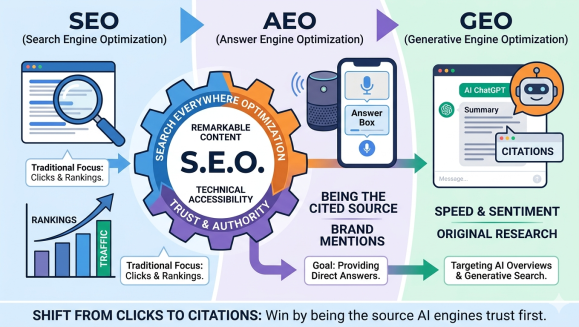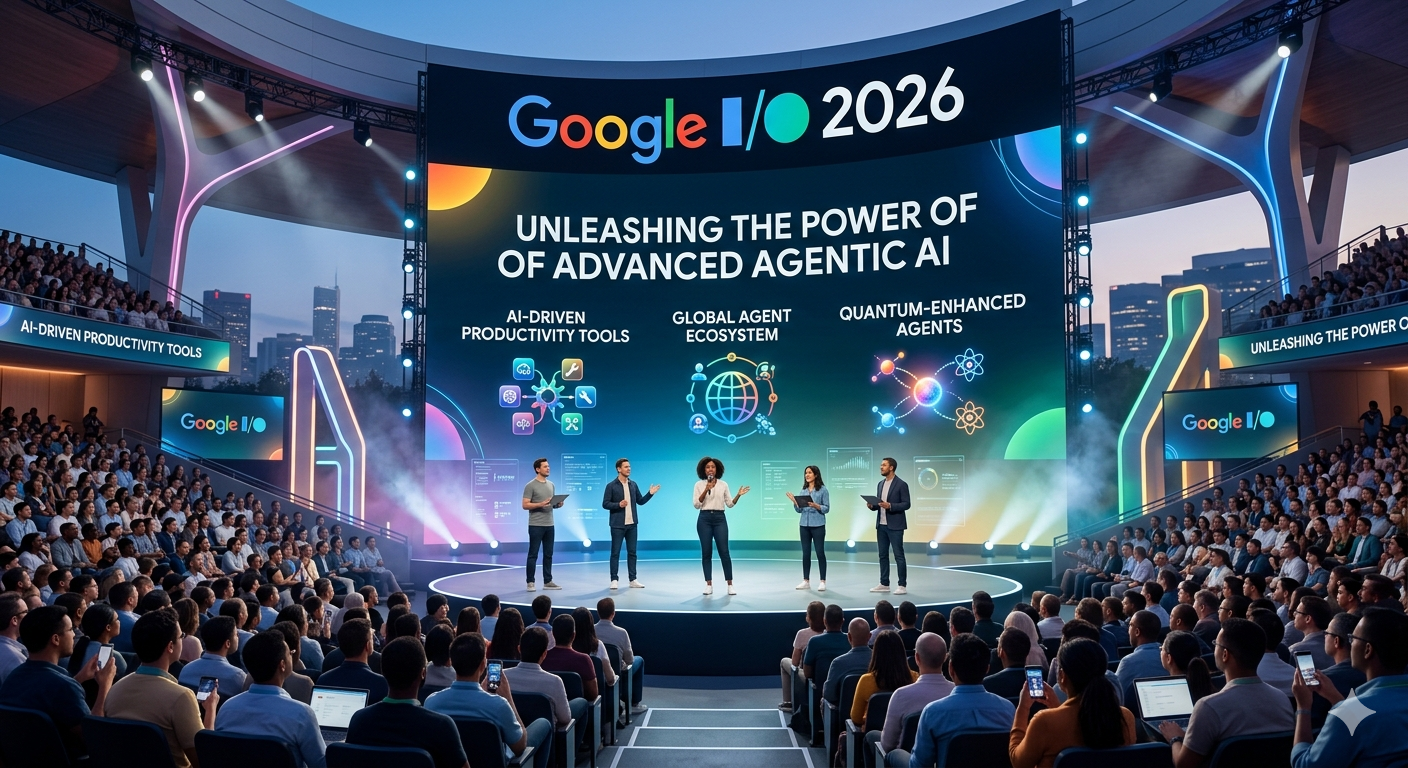
Google I/O 2026 was not just about faster models. It was about AI that listens, sees, searches, shops, writes, edits, builds, plans, and acts. The keynote moved quickly, but the message was simple: AI is moving out of the chat box and into the real world — Maps, YouTube, Docs, Search, shopping, glasses, science, and the everyday flow of life.
This was Google’s clearest statement yet: the next phase of AI is not only about answers, it is about action.
📌 Chapter 1: Search Becomes a Conversation Everywhere
The keynote opened with a familiar insight: people don’t search with neat keywords anymore — they ask messy, human questions. Google used Maps as the first example: Ask Maps now lets people ask complex contextual questions, not just "dress shop near me." The same conversational ability is spreading to YouTube: Ask YouTube turns video search into a guide. You ask a precise question; YouTube gives a clear overview, highlights tips, recommends relevant videos, and jumps straight to the part that answers your query. And you can follow up, compare options — YouTube remembers your goal.
📌 Chapter 2: Docs Live Turns Brain Dumps Into Drafts
Docs Live arrived as a voice-led creation tool. The user spoke naturally, mentioned an alumni talk, resume, email, then asked for funny analogies and better formatting. Docs Live followed along — pulling info from Drive, using Gmail details — turning loose thoughts into structured drafts, tables, bold reminders. The document no longer begins with a blank page; it begins with a thought. Coming first to Pro/Ultra subscribers, with similar abilities in Gmail and Keep.
📌 Chapter 3: Gemini Omni — Any Input to Any Output
Gemini Omni combines reasoning with Google’s generative media models. It can create from text, images, video, references, even existing footage. The demo showed a claymation explainer about protein folding, but the real breakthrough is conversational video editing: start with your own video, change the scene, alter style, add objects, reshape mood. As the speaker said, “a Nano Banana for video” — editing becomes conversational.
🔒 Chapter 4: Trust, Watermarks, and Content Credentials
As generative media gets more realistic, Google doubles down on provenance. SynthID and content credentials expand to Search and Chrome — you can circle an image in Search or right-click in Chrome to ask if it was AI-generated. OpenAI, Kakao, ElevenLabs are adopting SynthID. AI creation needs AI verification: the more realistic synthetic content becomes, the more important provenance gets.
⚡ Chapter 5 & 6: Gemini 3.5 Flash + Antigravity 2.0
Gemini 3.5 Flash is faster, more capable, and designed for real-world agentic tasks. It improves across benchmarks (including GDPval). Meanwhile, Antigravity 2.0 becomes an agent-first workspace: full CLI, SDK, voice, sub-agents, asynchronous task management, multi-agent orchestration. The demo built an operating system from scratch — and ran Doom. The message: agents that plan, build, test, and manage long workflows are here.
🤖 Chapter 7: Gemini Spark — Personal AI Agent
Gemini Spark is a personal AI agent that acts on your behalf. It runs on dedicated Google Cloud VMs, keeps working even when your laptop is closed. In the demo: “Find upcoming meetings with Sundar and colour them hot pink. Write a note to a new neighbour. Create a school checklist.” Spark listened to the whole request, broke work into individual threads. This is the shift from AI chat to AI delegation. Rolling out to trusted testers, then Ultra subscribers, and later to Chrome.
🔍 Chapter 8 & 9: Agentic Search + Generative UI
Google unveiled the biggest upgrade to the search box in 25 years: accepts text, images, files, video, reasons across them. AI Overviews + AI Mode become one seamless AI Search experience. But the larger shift is agentic search: set information agents to monitor the web, track topics, find updates, and help you take action. Also, Generative UI comes to Search: ask about black holes, Search builds an interactive visual; ask about binary black holes, it creates a custom simulation. Answers become tools, calculators, visual models — generative UI at the scale of Search.
Universal Cart
Cross-merchant cart that looks for deals, tracks price drops, and notifies you. Shopping becomes a continuous AI layer across Search, Gemini, YouTube & Gmail.
Neural Expressive
Gemini’s redesigned interface: fluid animations, richer colors, haptics, and built-in creative templates. Approachable and powerful.
Daily Brief + Proactive AI
Gemini’s out-of-the-box agent that gathers inbox, calendar, tasks, and suggests next steps before you ask. Proactive, not just reactive.
🎤 Chapter 13 & 14: Voice on Mac + Google Pics & Flow
The Gemini Mac app now allows you to select files in Finder, hold a key, dictate an email — Gemini reads PDFs and images, extracts details, fixes mistakes, drafts the message. For creative work, Google Pics (image editing for flyers, infographics) and Flow (AI video environment transforms with Omni) now include agents — one image can become many video angles, a scene shifts from morning to night. Flow Music turns a piano riff into an R&B demo: AI as a creative collaborator, not the whole process.
👓 Chapter 15: AI Glasses Bring Gemini Into the Real World
Google’s first audio glasses arrive this fall — no display, Gemini speaks privately. They help with music, photos, calls, navigation. The live demo: “Navigate to where I met a friend last week” — Gemini understood context, offered a coffee stop, ordered usual coffee via DoorDash, summarised missed family dinner plans, added to calendar. Later, glasses connected to a watch for glanceable display: take audience photo, transform into a cartoon, add a blimp with “Google I/O 2026.” The interface becomes voice, context, glasses — AI beyond screens.
🛡️ Chapter 16 & 17: Safety, CodeMender & Gemini for Science
AGI is on the horizon — Google introduced CodeMender, a code security agent that automatically finds and fixes vulnerabilities. And Gemini for Science: tools to help researchers keep up with papers, turn goals into code, generate new hypotheses. AlphaEarth Foundations as a digital twin of the planet for deforestation & food security. Isomorphic Labs accelerates drug discovery for immune disorders and cancer. AI as a force multiplier for human ingenuity.
Google I/O 2026 drew a clear line: AI is no longer waiting for the next prompt. It is starting to move. From Ask YouTube to Docs Live, Omni video editing, Universal Cart, and AI Glasses — the new era is agentic, proactive, and deeply integrated.